
Curry County Three-Day Release View
The official Curry County JusticeConnect roster offers a “Booked and Released” status filter. It does not offer a button called “72 hours,” “three days,” or “weekend releases.” The three-day range must be calculated from the individual Release Date fields. This method is useful for reviewing several days at once, but the result is not a complete county-certified feed.
A wider interval helps when someone checked late, when the exact day is uncertain, or when a weekend spans more than one calendar date. It also adds a risk: entries may be sorted or retained in ways the county does not explain. List position cannot substitute for a date. Open every plausible record and distinguish Scheduled Release, which is forward-looking, from an actual Release Date.
Build Curry County’s 72-Hour List
Set the start of the search period before opening the roster. A “last 72 hours” inquiry is a moving interval, while “the last three calendar days” can cover a different span. Write down the start and end date and time so borderline entries can be handled consistently.
- Open JusticeConnect and select “Booked and Released” from the View menu.
- Review likely names, then open each detail rather than relying on the grid alone.
- Compare name, age, sex, booked date, docket, arresting agency, and charge details.
- Read Release Date. Do not count Scheduled Release as an event that has happened.
- Keep entries whose actual release date falls within the chosen interval.
- Check the other status choices when the expected record is absent.
- Confirm uncertain results with Corrections or request the release transaction.
The Curry County same-day release process is the better fit when only today matters. Its tighter scope reduces the number of details that must be checked.
Curry County 72-Hour Release Fields
The roster grid is designed for scanning, not for certifying a three-day report. It shows an image, name, age, sex, Booked Date, and Scheduled Release. Opening a record exposes the fields needed to decide whether the booking belongs in the chosen period.
| Field | Use in a 72-hour review |
|---|---|
| Name and physical details | Distinguish people with similar names. |
| Booked Date | Places the start of the jail stay, not its end. |
| Scheduled Release | Shows a possible future date that can change. |
| Release Date | Determines whether the event falls in the chosen span. |
| Days Served / Total | Adds custody context but not the legal release reason. |
| Facility and status | Separates Curry release from conditional status or transport. |
| Docket, charges, bail | Links the booking to court and release authority. |
Release type is not one universal field. “Dismissed,” “Did Not File,” “Conditional Release,” and “House Arrest” may explain why physical jail custody ended, while “Transport” points toward continued custody. The jail transaction and Curry Circuit Court record should resolve the legal basis when a category alone is too broad.
Note: A booking photo identifies the source event; it does not prove conviction, release reason, or present custody status.
Curry County Weekend Release Review
A three-day review is especially useful when an inquiry crosses Saturday and Sunday or a public holiday. Curry County publishes no special weekend-release schedule, no standard processing time, and no rule that every weekend event posts by the next workday. Do not claim that a person was held longer or released later merely because an online detail appeared after the expected date.
Use the actual date stored in the detail, then ask Corrections about close cases. If the roster gives “Unknown,” if an entry is absent, or if only a scheduled date appears, request the release transaction. That record can supply the actual date and time, release authority, and receiving agency when those fields are held and disclosable.
Weekend timing also changes the practical search order. The Corrections line operates 24 hours, while written records processing is not an instant confirmation channel. Oregon VISOR can provide a release or transfer alert for a registered person, but it is not a certified record and updates can lag. Preserve an alert, then pair it with the jail or agency record.
Curry County Roster Retention Limits
JusticeConnect has a visible refresh control. That proves only that a visitor can reload the display. It does not state how often Curry data reaches the system, how long a released record remains available, or whether entries are removed on a fixed schedule. The official sources reviewed gave no 24-hour, 72-hour, or longer retention promise.
The roster’s “Booked and Released” filter remains valuable because it preserves more release-oriented context than a current-only roster. Still, an older entry may be gone, a new one may not yet be visible, or the person may sit under another status. Search Conditional Release, Dismissed, Did Not File, House Arrest, Sentenced, and Transport before concluding that the record is missing.
The JusticeConnect View menu illustrates why the search is based on status choices rather than a documented time feed.
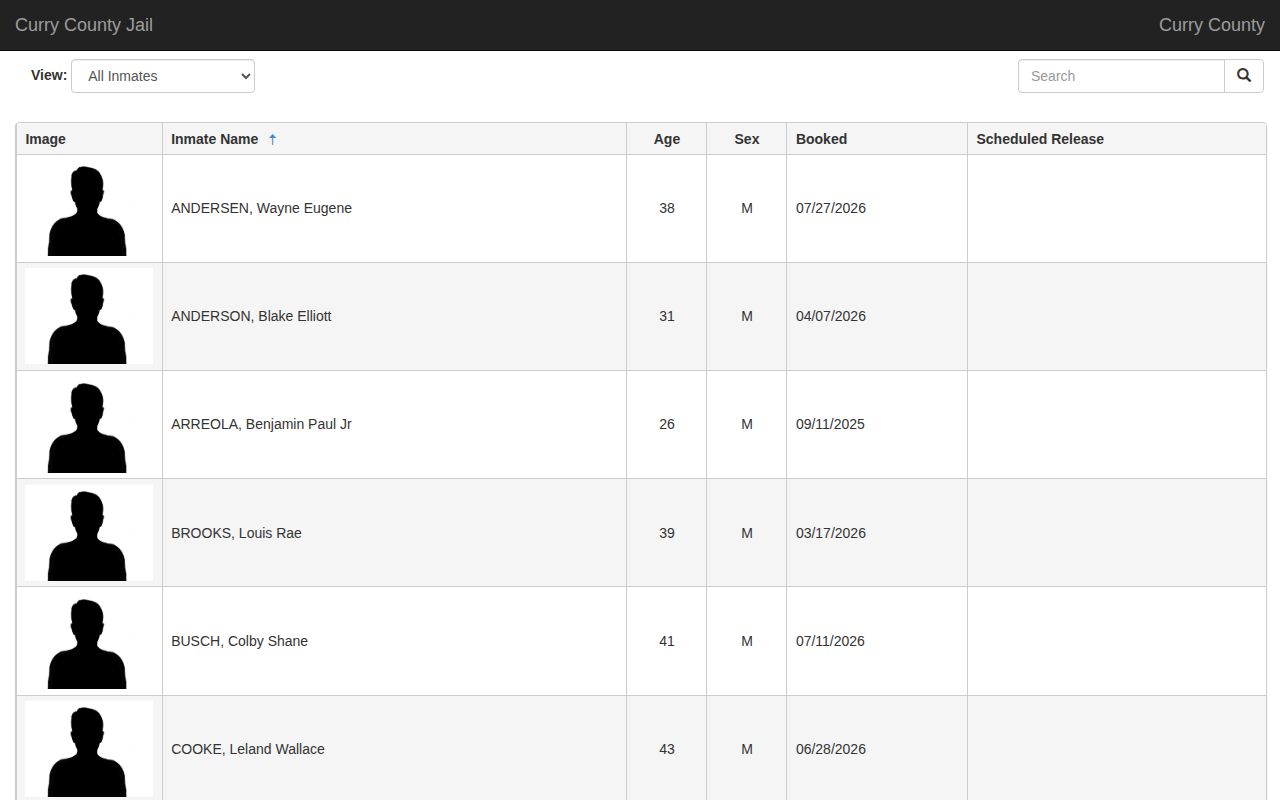
The screenshot supports the available categories only. It does not establish completeness, cadence, or a three-day retention rule.
Curry County Three-Day Records Fallback
A written request is the strongest fallback when several days must be reconstructed. Use the Curry County Sheriff form and provide a narrow date range. For one person, include the full name, booking date, and case number if known. Ask for the booking record, actual release date and time, release authority or reason, and destination or receiving agency if releasable.
The form quotes $25 for an Incident Report / Dispatch Record / Jail item. It accepts check, cash, money order, or credit card with a vendor fee. Mail and payment go to Attention Records, 94235 Moore Street, Suite 311, Gold Beach, OR 97444. A current agency estimate should control because a broader request may require clarification or added cost.
Curry Circuit Court provides the judgment and Register of Actions that explain dismissal, sentence, security release, or another court result. Court data may lag and does not usually supply the exact door-out time. Use it with the jail transaction, not in place of it.
Curry County Release Paths Compared
A person can leave Curry County Jail without entering the community. Status labels, court records, and receiving-agency searches prevent that mistake. Each custody system answers a separate question.
| Path | Meaning | Confirmation source |
|---|---|---|
| Community release | Curry jail custody ended through an authorized release. | Jail transaction and court disposition. |
| Conditional status | Confinement ended while legal controls remained. | Release agreement, court record, and VISOR. |
| ODOC transport | Curry custody ended but state incarceration began or continued. | Oregon Offender Search, VISOR, and ODOC records. |
| Federal transfer | A federal authority took or continued custody. | U.S. Marshals context and BOP after delivery. |
| ICE transfer | Immigration custody followed the jail departure. | ICE locator and agency documentation. |
Oregon VISOR searches people currently in custody or under supervision. Someone released from confinement may still appear because supervision continues. A fully discharged person may not appear. Neither outcome alone proves what happened during the three-day interval.
Missing Curry County Release Entries
When a person vanishes from the current list and does not appear under “Booked and Released,” do not label the event a release. Try spelling variants and other status views. Record any docket or arresting-agency data already known. The person could have been transported, placed in another status, or removed after an unknown retention period.
Call Corrections at 541-247-3344 next. Ask whether the person was released, transported, or remains under another category. If a Transport or state sentence appears, use the Oregon Offender Search and VISOR. If a federal or immigration hold appears, use that agency’s channel. For an older Curry event, the sheriff record plus Curry Circuit Court disposition is the sound chain.
A court record can preserve useful facts after a short jail entry disappears. The docket may show a dismissal, security-release agreement, sentence, amended judgment, probation, or another order. It does not usually record the exact moment a person walked out of Curry County Jail. Pair it with the jail transaction. If the judgment commits the person to ODOC, the departure belongs in the transfer branch, and the Oregon Offender Search becomes the next custody locator.
When the task changes from reviewing a date range to locating one person across agencies, follow the Curry County released inmate search through jail, court, state, and federal channels.
Likewise, a VISOR no-match does not prove release within the last 72 hours. VISOR covers people currently in Oregon custody or under supervision and is not a permanent archive of full discharge. A spelling variation, offline jail, transfer outside its scope, or update lag can cause the same result. The jail record remains the direct source for the Curry event.
Note: No official Curry Sheriff mobile app or routine social-media release stream was verified, so neither belongs in the fallback chain.